Thermal Mass Dynamics
Earth-sheltered homes, often called bermed or underground houses, operate on the principle of thermal lag. While air temperatures fluctuate wildly between day and night, soil temperature remains remarkably stable at depths below 1.5 meters (5 feet). In most temperate climates, the ground temperature at this depth stays between 10°C and 15°C (50°F–59°F) year-round.
By wrapping a structure in earth, we utilize the soil as a massive heat sink. During the summer, the earth absorbs excess heat from the interior, keeping the living space cool. In winter, the surrounding mass prevents heat from escaping, maintaining a baseline temperature that requires minimal supplemental heating. Practice shows that these homes maintain a "flywheel effect," where internal temperatures remain steady even during week-long power outages.
According to the U.S. Department of Energy, earth-sheltered homes can save 50% to 70% on heating and cooling costs compared to traditional stick-built homes. Furthermore, the high thermal mass of concrete walls (standardly 20–30 cm thick) allows for a phase shift of 8 to 12 hours, meaning the heat of midday only reaches the interior during the coolness of the night.
Common Design Pitfalls
The most frequent error in earth-sheltered construction is the "refrigerator effect," where poor ventilation leads to high humidity and mold. Builders often assume that because the home is underground, it doesn't need insulation. In reality, without a thermal break between the concrete shell and the surrounding soil, the walls can become uncomfortably cold to the touch, leading to condensation issues.
Structural failure is another critical risk. A cubic meter of wet soil can weigh up to 2,000 kg. Standard residential framing cannot support the lateral pressure of several meters of earth. Neglecting professional hydrostatic pressure calculations often results in cracked foundations or wall bowing within the first five years of the home's life.
Finally, many DIY enthusiasts fail to account for radon gas. Since these homes are surrounded by soil, radon—a naturally occurring radioactive gas—can seep through micro-cracks in the slab. Without a dedicated radon mitigation system or a continuous vapor barrier (like Stego Wrap), the health risks become a long-term liability for the inhabitants.
Precision Integration
Optimizing Solar Gain
To balance the cooling effect of the earth, south-facing glazing is essential. High-performance windows, such as those from Andersen or Pella, should feature a high Solar Heat Gain Coefficient (SHGC) to allow winter sun to penetrate deep into the room. This solar energy is then stored in the high-density floor—usually polished concrete or stone tile—acting as a secondary thermal battery.
Selecting High-Density Materials
Thermal mass only works if the material has high volumetric heat capacity. Concrete, rammed earth, and brick are the industry standards. Avoid using wood or carpet over the thermal mass, as these act as insulators and prevent the heat exchange between the air and the storage medium. For best results, use a 100mm to 150mm thick concrete slab for internal partitions.
Advanced Waterproofing
Sub-grade structures require a "belt and suspenders" approach. Use a primary membrane like Carlisle CCW-800 or a bentonite clay mat (Volclay). This should be protected by a dimpled drainage board (like DELTA-MS) to relieve hydrostatic pressure. If water cannot build up against the wall, it cannot leak through it.
Mechanical Ventilation (ERV)
Because earth-sheltered homes are exceptionally airtight, an Energy Recovery Ventilator (ERV) is mandatory. Systems like the Zehnder ComfoAir exchange stale indoor air with fresh outdoor air while transferring the heat/coolness between the streams. This maintains a 40–50% humidity level, preventing the damp "basement smell."
Strategic Site Orientation
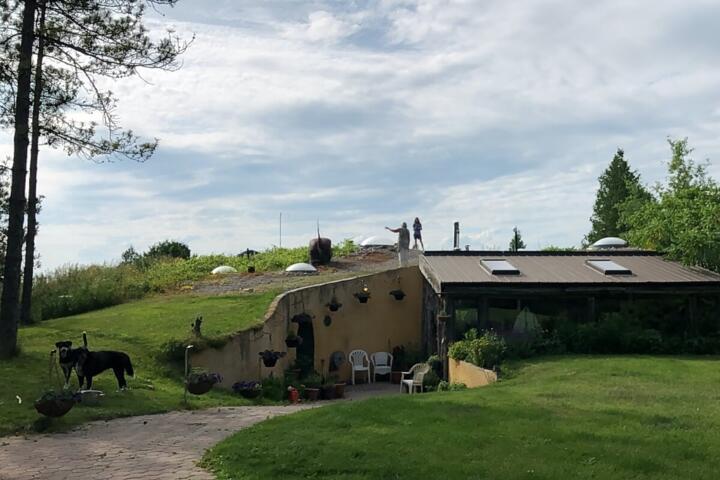
The slope of the land dictates the home's efficiency. An south-facing "elevational" design—where only the front is exposed—is the most effective for the Northern Hemisphere. This maximizes natural light and passive solar heating while the remaining three sides benefit from the earth's 13°C (55°F) baseline stability.
Performance Benchmarks
A notable example is the "Earthship" concept popularized in New Mexico. One specific residence used recycled tires packed with earth to create 80cm thick walls. During a record-breaking winter with outdoor lows of -20°C, the interior temperature never dropped below 17°C, despite the owner only using a small wood stove for two hours in the evening.
Another case involves a modern bermed residence in the UK. By utilizing a "Passive House" certified envelope integrated with earth-sheltering, the home achieved an airtightness of 0.5 ACH (Air Changes per Hour). The annual energy bill for heating a 200m² space was reduced to under £300, whereas a traditional neighboring house of the same size spent over £1,800 annually on natural gas.
Component Checklist
| Component | Requirement | Recommended Brand/Method |
|---|---|---|
| Structural Shell | Reinforced Concrete (C35/45) | Custom Poured-in-Place |
| Waterproofing | Self-healing Membrane | Bentonite or EPDM (Firestone) |
| Insulation | Extruded Polystyrene (XPS) | Owens Corning FOAMULAR |
| Ventilation | Energy Recovery (ERV) | Zehnder or Broan-NuTone |
| Vapor Barrier | 15-mil Polyethylene | Stego Wrap |
| Monitoring | Hygrometer/Smart Thermostat | Ecobee with Remote Sensors |
Avoiding Execution Errors
Do not skip the geotechnical report. You must know the soil's load-bearing capacity and the water table depth before digging. If the water table is high, an earth-sheltered home can turn into a "boat," risking structural lifting or catastrophic flooding. Always install a redundant French drain system around the perimeter footer.
Avoid "over-glazing" on the north side. While windows provide light, every north-facing window in an earth-sheltered home is a massive thermal leak. Use light tubes (like Solatube) to bring natural light into the rear of the house without sacrificing the thermal benefits of the earth cover.
FAQ
Is it dark inside?
Modern designs use "atrium" layouts or south-facing glass walls. When combined with light-reflective interior finishes and skylights, earth-sheltered homes are often brighter than traditional houses with small windows.
How do you handle sewage?
Since the home is lower than the ground level, a sewage ejector pump (like a Liberty Pumps 700-series) is often required if the main sewer line or septic tank is at a higher elevation.
What about resale value?
While once considered "niche," the rise in energy costs has made high-efficiency homes more desirable. Financing can be obtained through green mortgages or lenders familiar with sustainable construction like the Ecology Building Society.
Is insurance more expensive?
Actually, insurance is often cheaper. These homes are fireproof, windproof (tornado/hurricane resistant), and virtually immune to termites and rot, leading to lower premiums from providers like State Farm or USAA.
Does the roof leak?
With modern liquid-applied membranes and proper drainage layers, earth roofs are no more prone to leaks than standard flat roofs. Most modern systems carry a 20- to 50-year warranty.
Author’s Insight
Having consulted on several high-thermal-mass projects, I’ve found that the most satisfied homeowners are those who treat the home as a living system. My biggest piece of advice: do not skimp on the drainage gravel. Use at least 30cm of clean, crushed stone behind your walls to ensure water reaches the footer drains instantly. An earth-sheltered home is only as good as its ability to stay dry.
Summary
Earth-sheltered homes offer a definitive solution for those seeking climate resilience and energy independence. By combining the natural thermal mass of the earth with modern waterproofing and air-exchange technologies, it is possible to create a dwelling that remains comfortable with minimal mechanical intervention. To succeed, prioritize a robust structural design, invest in premium moisture barriers, and ensure a constant supply of fresh air through ERV systems. Building into the earth is not just an architectural choice; it is a long-term investment in stability and sustainability.