Strategic Land Prep
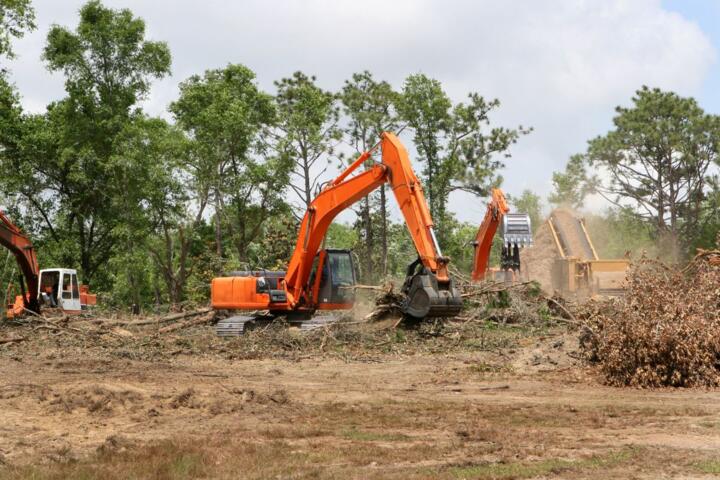
Land clearing is the foundational step of any construction or agricultural project, involving the removal of vegetation, boulders, and debris. In the industry, we view this not just as "cleaning" but as site engineering. Using a heavy crawler like a Caterpillar D6 is about raw force and speed, capable of clearing acres in a single shift. Conversely, manual labor focuses on surgical precision, often required in sensitive ecological zones.
For example, on a recent 5-acre residential project in Georgia, a team using a mid-size bulldozer cleared the buildable area in 12 hours. A manual crew would have taken 10 days for the same footprint. However, the bulldozer removed 4 inches of vital topsoil, whereas a manual crew would have preserved it. Statistically, mechanical clearing can be 85% faster, but it can increase soil erosion risks by up to 40% if not managed with silt fencing and proper grading.
Current market rates show that hiring a professional operator with a heavy-duty dozer typically costs between $150 to $250 per hour. Manual labor crews usually bill per man-hour, often resulting in a higher total project cost for large-scale acreage but lower mobilization fees for micro-tasks under half an acre.
Critical Site Errors
The most frequent mistake I see is "over-clearing." Project managers often hire a heavy machine to clear everything to the property line without considering the cost of replanting. Removing mature oaks or maples that could have been integrated into the landscape design can devalue a residential property by as much as 15% to 20%. Replacing those trees later is ten times more expensive than preserving them during the initial phase.
Another pain point is underestimating the "stump problem." Bulldozers are excellent at pushing trees over, but they often leave massive root balls or buried debris. If these are simply buried instead of hauled off—a common "shortcut"—the decomposing organic matter creates sinkholes five to ten years later. This can lead to foundation cracks in structures built over these "burn pits" or burial sites.
Failure to obtain SWPPP (Stormwater Pollution Prevention Plan) permits is a legal nightmare. In states like California or Florida, clearing more than one acre without a permit can result in daily fines exceeding $10,000. Heavy machinery disturbs the earth's crust significantly more than foot traffic, making mechanical clearing a high-stakes activity regarding environmental compliance.
Precision Solutions
Calculating Slope Grades
Before choosing your method, measure the "grade" or steepness of your terrain. Bulldozers become dangerous and lose traction on slopes exceeding 35 degrees. For steep embankments, manual labor or specialized "spider" excavators are the only viable options. Using the wrong tool on a slope leads to machine rollovers and massive liability.
Assessing Soil Density
In regions with heavy clay or marshy conditions, a 20-ton bulldozer will sink, creating "ruts" that ruin drainage. In these cases, we recommend manual labor or low-ground-pressure (LGP) equipment. For instance, using a John Deere 650K LGP with wider tracks minimizes the "pounds per square inch" (PSI) exerted on the ground, preventing soil compaction.
Defining Modern Gear
Don't assume manual labor means just an axe and a shovel. Professional "hand" crews utilize high-performance tools like the Stihl FS 561 C-EM clearing saw or Milwaukee M18 FUEL chainsaws. These tools allow a 4-man crew to clear dense underbrush at a rate of roughly 0.25 acres per day without disturbing the root systems of protected species.
Managing Wood Waste
What happens to the debris? A bulldozer creates massive "slash piles." You must then pay for a tub grinder (approx. $500/hour) or haul-off fees (approx. $300 per truckload). Manual crews often use "lop and scatter" methods or small wood chippers like a Vermeer BC1000XL, which turns waste into onsite mulch, saving on disposal costs.
Navigating Zoning Laws
Check your local Tree Preservation Ordinance (TPO). Many municipalities require a certified arborist to flag "heritage trees" before a bulldozer enters the site. If a machine operator nicks the bark of a protected tree, the fines can be staggering. Manual labor is often mandated within the "Dripline" or Critical Root Zone (CRZ) of these trees.
Real-World Outcomes
Case Study A: The Suburban Subdivision
A developer in North Carolina needed to clear 15 acres of pine forest. They opted for a fleet of Komatsu D61PX dozers.
Results: The site was cleared and grubbed in 8 business days. The total cost was $28,000. However, the heavy compaction required them to spend an additional $6,000 on deep ripping the soil to allow for proper lawn drainage later. Total: $34,000.
Case Study B: The Eco-Friendly Estate
A homeowner in Oregon had 2 acres of dense blackberries and small saplings. They chose a 3-man manual crew over a small skid-steer.
Results: The crew spent 5 days using brush cutters and hand-pulling invasive species. Cost: $4,500. The primary benefit was the total preservation of the native topsoil and no damage to the existing creek bed, which would have been ruined by a machine's tracks. Total: $4,500.
Methodology Comparison
| Feature | Heavy Bulldozer | Manual Labor Crew |
|---|---|---|
| Best For | Large acreage (2+ acres), stumps, boulders | Small lots, steep hills, sensitive zones |
| Daily Output | 1.5 to 3 acres | 0.1 to 0.25 acres |
| Cost (Approx) | $1,500 - $3,000 per day | $800 - $1,500 per day |
| Soil Impact | High (compaction and topsoil loss) | Low (minimal disturbance) |
| Waste Disposal | Requires heavy hauling/grinding | Often mulched or composted onsite |
Avoiding Costly Risks
Never hire an operator who doesn't carry Inland Marine Insurance and general liability coverage. If a bulldozer hits an underground gas line or a fiber-optic cable, the repair costs can reach six figures. Always call 811 to mark utilities before any blade touches the dirt. Manual labor is safer for utility-dense areas, but "strike" risks still exist.
Avoid clearing during the peak "wet season." A bulldozer in the mud is a recipe for a disaster known as "pugging," where the soil loses all structure and becomes a slurry. This can delay a construction project by months as you wait for the ground to dry and stabilize. If you must clear in the rain, manual labor is significantly less destructive to the site's hydrology.
FAQ
Is it cheaper to clear land myself?
Only if you own the equipment. Renting a mid-size dozer costs roughly $800/day plus delivery and fuel. Without experience, you risk damaging the machine or the land, which leads to "repair" costs that far exceed professional fees.
Can a bulldozer remove large stumps?
Yes, machines like the CAT D8 are designed for this. However, "grubbing" (removing roots) leaves large holes that must be filled with structural fill dirt and compacted to 95% Proctor density if you plan to build over them.
What is the 'select thinning' method?
This is a hybrid approach where a manual crew removes invasive species and "ladder fuels," while a small machine (like a Bobcat with a mulching head) handles the larger debris. It is the gold standard for wildfire mitigation.
How do I handle the leftover brush?
You have three choices: Burning (requires a permit and favorable wind), Mulching (best for soil health), or Hauling (most expensive). Bulky brush piles from dozers often require a permit for "Air Curtain Burners" in many jurisdictions.
Do I need a permit for manual clearing?
Usually not for brush and small saplings (under 4 inches in diameter). However, removing "protected" species by hand still requires authorization in many coastal or protected forest regions.
Author’s Insight
In my two decades of site management, I’ve learned that the "fastest" way is rarely the most cost-effective in the long run. I once saw a client save $5,000 by using a bulldozer to clear a wooded lot, only to spend $12,000 a year later on retaining walls because the machine destroyed the natural root-binding on a slope. My rule of thumb: use a bulldozer for the house pad and driveway, but keep the machines out of the "buffer zones" where you want your landscape to thrive. Always walk your property with a roll of "caution tape" and mark the trees you want to keep before the equipment arrives; once a blade hits a trunk, there is no going back.
Summary
Choosing between a bulldozer and manual labor depends on your project's scale, budget, and environmental goals. Use heavy machinery for rapid, large-scale clearing where soil compaction is not a primary concern. Opt for manual labor for precision work, steep terrain, and projects where preserving the natural ecosystem adds long-term value. For the best results, hire a contractor who offers a hybrid approach, combining the efficiency of a skid-steer or dozer with the surgical care of a hand crew.