Tech Landscape Today
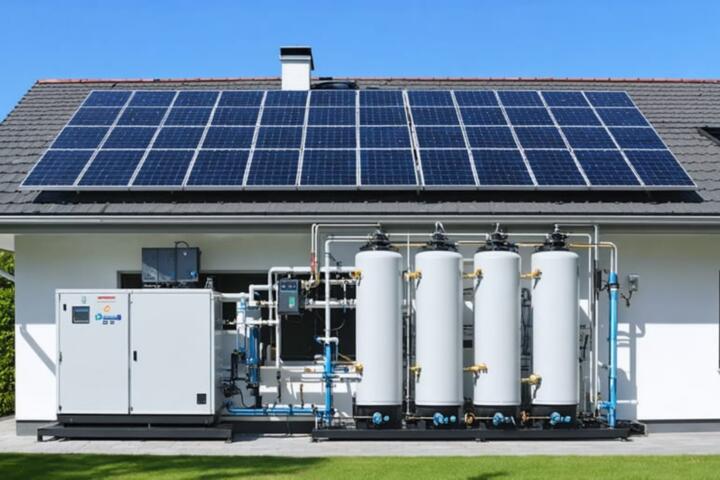
The concept is simple: use excess solar energy to split water into hydrogen via electrolysis, store that gas in tanks, and run it through a fuel cell when the sun goes down or the grid fails. While lead-acid and lithium-ion batteries are the standard, they suffer from "self-discharge" and limited energy density for long-term seasonal storage.
In practice, companies like Picea by HPS (Home Power Solutions) are already installing integrated units in Europe. These systems combine an inverter, electrolyzer, and fuel cell into one cabinet. A single unit can store up to 1,500 kWh of energy—roughly 100 times the capacity of a standard Tesla Powerwall 2.
Real-world data shows that while a lithium battery might lose 1-5% of its charge per month just sitting idle, hydrogen stored in pressurized tanks remains stable for years. Currently, the round-trip efficiency of residential hydrogen (power-to-gas-to-power) sits around 35% to 40%, which is significantly lower than the 90% seen in lithium-ion.
Current Pain Points
The Efficiency Gap
Most homeowners underestimate the energy loss during the conversion process. For every 10 kWh of solar energy you put into an electrolyzer, you might only get 3.5 kWh back as electricity. This requires a massive solar array—often 15 kW or more—to ensure there is enough "surplus" to waste on the conversion while still powering the home.
Infrastructure Barriers
Installing a hydrogen system isn't as simple as mounting a box on a wall. You need specialized plumbing for deionized water, outdoor space for high-pressure storage tanks (usually 300 bar), and strict adherence to local fire codes. Many municipal inspectors in the US and UK still lack a standardized framework for residential hydrogen permits.
High Capital Expense
A residential hydrogen setup currently costs between $80,000 and $120,000. For a standard 2,500-square-foot home, this is a hard pill to swallow compared to a $15,000 diesel generator or a $30,000 battery stack. The ROI is currently measured in decades, not years, unless government subsidies bridge the gap.
Maintenance Complexity
Fuel cells are sensitive to air quality and water purity. If the deionizer filter in your electrolyzer fails or if the ambient air contains high levels of pollutants, the Proton Exchange Membrane (PEM) can become "poisoned," leading to a permanent drop in voltage output and a very expensive repair bill.
Thermal Management
The process of turning hydrogen back into electricity generates significant heat. If a system is installed in a garage without a heat recovery loop, that energy is wasted. High-end systems attempt to use this for domestic hot water, but the integration adds another layer of mechanical failure points for the homeowner.
Strategic Solutions
To make hydrogen viable, you must adopt a "Hybrid Storage Strategy." Use a small lithium battery (5-10 kWh) for daily cycling (nightly loads) and reserve the hydrogen for "Long-Duration Energy Storage" (LDES). This prevents the fuel cell from cycling on and off constantly, which extends its lifespan.
Utilizing waste heat recovery is the secret to moving from 40% efficiency to nearly 85% total system efficiency. Systems like the Panasonic Ene-Farm use the byproduct heat from the fuel cell to provide constant hot water for radiant floor heating or showers. In cold climates, this makes the economics far more attractive.
On the hardware side, look for PEM (Proton Exchange Membrane) stacks rather than Solid Oxide (SOFC) for backup needs. PEM units can start up in seconds, whereas SOFCs require hours to reach operating temperatures, making them useless for sudden blackouts.
Brands like Enapter are now offering "AEM" (Anion Exchange Membrane) electrolyzers which are modular. Instead of one giant, expensive machine, you can stack small 2.4 kW modules. If one fails, your system stays online. This modularity is the industry's best answer to the reliability concerns of early adopters.
Residential Cases
In a remote project in the Swiss Alps, a mountain chalet replaced its diesel generator with a solar-hydrogen loop. The site had no grid access and 5 months of heavy snow. By installing a 20 kW solar array and a 500-liter hydrogen storage tank, they achieved 100% autonomy. The fuel cell provided 6 kW of continuous power, enough for medical equipment and basic utilities throughout the winter.
A tech executive in California installed a hydrogen backup system to combat "Public Safety Power Shutoffs." While his neighbors' batteries died after 12 hours, his hydrogen system ran for 6 consecutive days. He utilized the waste heat to keep his swimming pool at 80 degrees, effectively using the system as a co-generation plant.
Technology Comparison
| Feature | Lithium-Ion Battery | Hydrogen Fuel Cell | Diesel Generator |
|---|---|---|---|
| Discharge Duration | 4–12 Hours | Days to Weeks | Limited by Fuel Tank |
| Lifespan | 10–15 Years | 15–20 Years | 10–20 Years (with maintenance) |
| Maintenance | Minimal | Moderate (Filters/Water) | High (Oil/Filters/Fuel) |
| Emissions | Zero | Zero (Water Vapor) | High (CO2/Particulates) |
| Energy Density | Low | Extremely High | High |
Common Mistakes
The biggest error is "Sizing for the Peak." Homeowners often try to buy a fuel cell that can handle the peak start-up current of an air conditioner (e.g., 15 kW). This is incredibly expensive. Instead, use a battery buffer to handle the "surge" and size the fuel cell for the "base load" (e.g., 2-3 kW).
Ignoring water quality is a silent killer. Electrolyzers require ASTM Type II deionized water. Using tap water will ruin the expensive catalyst within weeks. Always factor in the cost of a high-quality reverse osmosis and deionization system as part of the initial install.
Another pitfall is neglecting ventilation. Even though hydrogen is non-toxic, it is the smallest molecule and prone to leaks. Indoor installations without proper hydrogen sensors and "spark-proof" exhaust fans are a significant safety risk that can void your home insurance.
FAQ
Is residential hydrogen storage safe?
Yes, when installed to code. Hydrogen is lighter than air and dissipates rapidly, unlike propane or gasoline vapors which "pool" on the ground. Modern tanks are carbon-fiber wrapped and designed to withstand extreme impact without rupturing.
Can I use my existing solar panels?
Yes, but you likely need more of them. Because of the conversion losses, you should aim for a solar capacity that is roughly 3x your daily consumption to ensure you can fill the hydrogen tanks during the summer months.
How loud is a fuel cell backup?
Unlike internal combustion engines, fuel cells have no moving parts except for small cooling fans and pumps. They operate at about 45-50 decibels, which is roughly the same volume as a modern refrigerator or a quiet conversation.
Does the hydrogen expire?
No. Unlike gasoline which degrades in 6 months or diesel which grows algae, hydrogen gas remains chemically stable indefinitely as long as the storage vessel remains sealed. This makes it the ultimate "set it and forget it" emergency fuel.
What is the typical footprint?
An all-in-one cabinet like the Picea occupies about 1.5 square meters. However, the external storage tanks require an additional 2-4 square meters of outdoor space, usually placed on a concrete pad away from windows and ignition sources.
Author’s Insight
In my years consulting on off-grid energy, I’ve seen hydrogen move from a laboratory curiosity to a legitimate, albeit expensive, luxury. If you live in an area with frequent, multi-day outages—like the Pacific Northwest or parts of Australia—batteries simply won't cut it. My advice to clients is always the same: don't look at hydrogen as a battery replacement; look at it as a "Green Generator." It’s the final 10% of the energy transition that allows you to cut the cord entirely without ever worrying about a cloudy week.
Summary
The technology for residential hydrogen backup is technically "ready," but the market is still in its early-adopter phase. For those with the budget and a high requirement for energy security, systems like those from HPS or Panasonic offer a glimpse into a fossil-free future. To move forward, start by auditing your "base load" versus "peak load" and prioritize a hybrid setup that uses lithium for speed and hydrogen for endurance. As hardware costs drop through modularity, hydrogen will likely become the standard for seasonal energy resilience.