Slope Failure Mechanics
Slope erosion is primarily driven by two forces: hydraulic impact from raindrops and the sheer force of surface runoff. When gravity exceeds the cohesive strength of the soil, surface layers detach. On a bare 2:1 slope (50% grade), water velocity can reach speeds that displace several tons of topsoil in a single heavy rain event.
Practical experience shows that "hard armoring" with concrete often fails due to hydrostatic pressure buildup behind the wall. In contrast, "soft armoring" using plants and textiles allows for water infiltration while pinning the soil in place. A 2023 study on bioengineering indicated that slopes integrated with coir netting and native grasses experienced 85% less sediment loss compared to untreated control sites.
Slope Management Risks
The most common failure point is the "hydroseeding fallacy," where property owners spray grass seed on a steep bank without mechanical reinforcement. Heavy rain typically washes the seed to the bottom of the hill before germination can occur, leaving the slope exposed. This results in deep gullying that eventually threatens the crown (top) of the slope.
Another significant issue is the use of non-biodegradable plastic netting. While cheap, these materials often trap local wildlife and eventually degrade into microplastics without ever truly integrating with the root systems. When these synthetic mats shift, they can actually pull the germinating vegetation out of the ground, exacerbating the very problem they were meant to solve.
Technical Solutions
Selection of Biodegradable Geo-Textiles
For temporary stabilization until plants establish, coir (coconut fiber) or jute blankets are the industry standard. Coir Matting 700 or 900 (grams per square meter) is recommended for slopes steeper than 2:1. These materials provide a high tensile strength and a lifespan of 3 to 5 years, which is exactly the window needed for perennial shrubs to develop a mature root architecture.
The Role of Permanent Turf Reinforcement Mats (TRMs)
In high-velocity flow areas like swales or 1:1 slopes, synthetic TRMs are necessary. Unlike simple blankets, TRMs are non-degradable, three-dimensional matrices. Products like Enkamat or Pyramat 75 act as a permanent artificial root system. When grass grows through the matrix, the combination of roots and plastic webbing can withstand water velocities exceeding 15 feet per second.
Biological Reinforcement: Root Architecture
Plants for erosion control must be categorized by their root types. For immediate surface protection, Creeping Red Fescue or Clover provides quick coverage. However, for deep stabilization, you must include "soil anchors" like Vetiver Grass or Deep-rooted Native Prairie Grasses. These species have vertical roots that can penetrate 10 feet deep, effectively acting as living rebar.
Hydraulic Seeding and Mulch Tackifiers
On large-scale projects where manual matting is cost-prohibitive, high-performance flexible growth media (FGM) is used. Products like Flexterra HP-FGM are sprayed on as a slurry. This material creates a chemical bond with the soil surface, preventing movement even on near-vertical cliffs. It contains specialized polymers (tackifiers) that keep the seeds in place during the critical 14-day germination window.
Check Dams and Terracing for Runoff Interruption
On long slopes, "slope length" is the enemy. Water gains momentum as it travels down. Installing Wattles (straw or coir logs) every 10 to 20 feet breaks the flow. By interrupting the slope, you force the water to drop its sediment load and slow down, allowing the geo-textiles and plants below to absorb the energy more effectively.
Implementation Cases
Case Study 1: Coastal Bluff Stabilization
A construction firm managed a 45-degree coastal embankment suffering from wind and water erosion. They installed Coir 900 netting pinned with 12-inch biodegradable stakes and interplanted with American Beachgrass. Result: Zero visible erosion after a Category 1 hurricane, with 95% vegetation coverage achieved within one growing season.
Case Study 2: Highway Bypass Embankment
A public works department used a combination of TRMs and hydro-mulch on a 1.5:1 roadside cut. By using a permanent matting system instead of rip-rap (stones), they reduced material costs by 40% and eliminated the need for future herbicide treatments. The resulting "green wall" now filters runoff pollutants before they enter the local storm drain system.
Erosion Control Methods
| Method | Initial Cost | Durability | Best Application |
|---|---|---|---|
| Jute/Coir Blankets | Low-Moderate | 2-5 years | Standard slopes & plantings |
| Turf Mats (TRM) | High | Permanent | Channels & steep grades |
| Straw Wattles | Low | Seasonal | Breaking long slopes |
| Hydro-Mulch | Moderate | Short-term | Large inaccessible areas |
Preventing Failure
A frequent error is improper pinning. If the geo-textile is not in direct "intimate contact" with the soil, water will flow underneath the mat, creating "tenting." This actually accelerates erosion by hiding the rills until the entire mat collapses. You must use at least 2 to 3 staples per square yard to ensure the material mimics the terrain perfectly.
Neglecting the "toe" of the slope is another disaster. If the bottom of your erosion control system isn't trenched in (buried 6-12 inches), the water will undercut the bottom edge and pull the entire blanket down the hill. Always start your installation at the top (the crown) and overlap the higher layers over the lower layers, similar to shingles on a roof.
FAQ
Can I just use plastic tarps for erosion control?
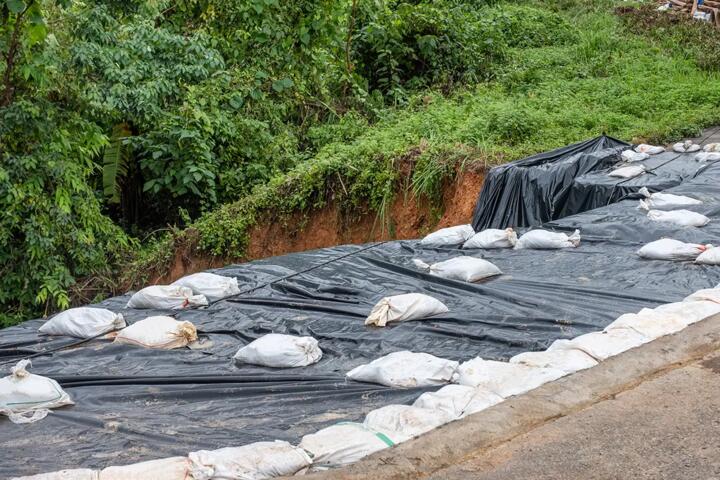
No. Plastic tarps are impermeable. They prevent water from entering the soil, causing massive runoff at the edges of the tarp, which creates even larger gullies. They also prevent any vegetation from growing, making the problem worse once the tarp is removed.
How long does it take for plants to stabilize a slope?
Most grasses offer surface protection within 4-8 weeks. However, deep-rooted structural stabilization from shrubs or woody perennials usually takes 2 to 3 full growing seasons to become fully effective.
Is coir or straw better for blankets?
Straw is cheaper but degrades in about 6-12 months. Coir is made from coconut fibers and lasts 3-5 years. Use straw for flat areas or very gentle slopes, and coir for anything steep or where the soil is poor and plants grow slowly.
Do I need to water the slope after installing textiles?
Yes. Geo-textiles can actually dry out the soil surface faster by absorbing heat. For the first month, consistent irrigation is required to ensure the seeds or plugs underneath the matting don't desiccate before they hit the groundwater table.
Will trees help stabilize my steep bank?
It depends. While roots help, the weight of a large tree on a saturated, steep slope can actually trigger a landslide. Use small-to-medium shrubs and grasses for the steep sections, and save the large trees for the top or bottom of the incline.
Author’s Insight
I’ve seen dozens of "perfect" engineering plans fail because they ignored local biology. You can buy the most expensive synthetic matting in the world, but if you don't choose plants that are native to your specific soil pH and sun exposure, the system will eventually collapse once the material reaches its fatigue point. My rule of thumb: The geo-textile is the "scaffolding," but the plants are the "building." Never spend more on the scaffolding than you do on the actual structure. Invest heavily in high-quality native seed mixes; they are the only truly permanent solution.
Summary
Successful erosion control on slopes is a balance of mechanical intervention and biological growth. Start by identifying the grade of your slope and selecting a geo-textile that matches the expected lifespan of your vegetation. Ensure "shingle-style" overlaps and proper trenching at the top and bottom to prevent undercutting. By integrating tools like Coir 900 or Enkamat with deep-rooted species like Vetiver, you move beyond temporary fixes to a self-sustaining landscape. Immediate action is essential; it is far more cost-effective to prevent topsoil loss today than to attempt to rebuild a collapsed hillside tomorrow.