The Green Catalyst
Growing up outdoors is more than just "playing"; it is a complex sensory experience that builds the foundational architecture of the brain. When a child navigates a literal uneven terrain, they are engaging in proprioceptive input that a flat carpeted floor cannot replicate. This physical navigation translates into neural pathways responsible for spatial reasoning and executive function.
Practically, consider the "Forest School" model popular in Scandinavia. Instead of plastic toys, children use sticks, stones, and mud. A child building a dam in a stream is practicing physics, fluid dynamics, and collaborative engineering without realizing it. They are learning the consequences of gravity and friction through trial and error, which fosters a "growth mindset" more effectively than a classroom lecture.
Statistically, the impact is measurable. Research published in The Lancet Planetary Health indicates that children raised in greener neighborhoods have up to a 55% lower risk of developing various psychiatric disorders later in life. Furthermore, a study by the University of Illinois found that just 20 minutes of walking in a park-like setting significantly improved concentration in children with ADHD, a phenomenon known as "Attention Restoration Theory."
The Sedentary Crisis
The primary mistake in modern parenting is the "over-sanitization" of play. By prioritizing safety and cleanliness over exploration, we inadvertently stunt a child's ability to assess risk. When children are kept primarily indoors, they lose the opportunity to develop "physical literacy"—the confidence to move their bodies through a 3D environment.
The consequences are visible in rising rates of pediatric myopia (nearsightedness), which has doubled in the last 50 years. This is largely due to a lack of exposure to natural daylight, which triggers dopamine release in the retina to prevent the eye from over-growing. Additionally, the "indoor generation" faces a Vitamin D deficiency crisis, with nearly 40% of American children lacking sufficient levels, impacting bone density and immune response.
Consider a typical suburban scenario: a child spends 7 hours at a desk, 2 hours on a bus/car, and 3 hours on a tablet. This lack of "unstructured" time means the child never learns to self-regulate boredom. They become dependent on external stimulation (algorithms), leading to decreased creative problem-solving skills and increased cortisol levels due to blue light overexposure.
Strategic Immersion
Micro-Adventures via AllTrails
To break the indoor cycle, families should utilize the AllTrails app to find "easy" rated hikes within a 10-mile radius. The goal isn't distance; it’s discovery. Using the app's offline maps allows kids to take the lead, teaching them basic navigation and map-reading skills. This builds autonomy and reduces the fear of the "unknown" woods.
Geocaching for Engagement
For children resistant to "just walking," Geocaching turns the outdoors into a global treasure hunt. By using GPS coordinates to find hidden containers, children practice coordinate geometry and persistence. It gamifies the environment in a healthy way, providing the dopamine hit of a digital game but within a physical, high-oxygen setting.
The 1000 Hours Outside Goal
The 1,000 Hours Outside movement provides a framework to match screen time with green time. By tracking hours using their downloadable charts, parents can visualize the deficit. Reaching this goal requires an average of 2.7 hours per day, which encourages "low-barrier" activities like eating dinner on a porch or doing homework under a tree.
Backyard Biodiversity Kits
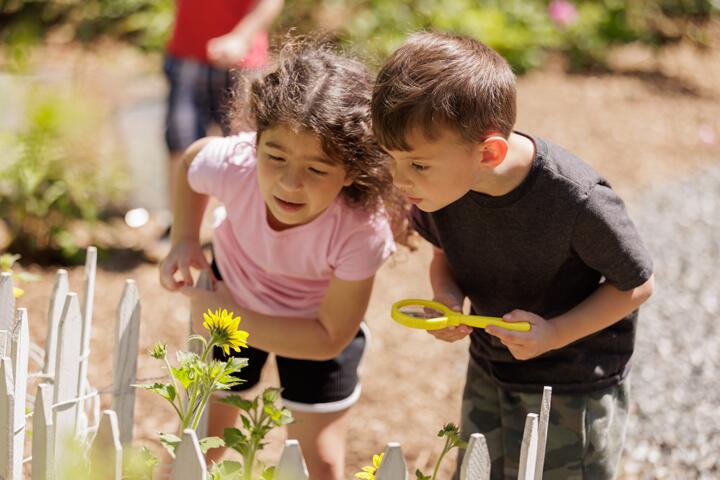
Tools like iNaturalist or the Seek app (by National Geographic) allow children to become citizen scientists. When a child identifies a Rare Blue Butterfly or a specific fungi species in their backyard, they develop an emotional connection to the land. This "biophilia" is the strongest predictor of future environmental stewardship and empathy.
Risky Play Frameworks
Implementing "Risky Play" involves allowing children to climb trees or use basic hand tools under supervision. According to the International Journal of Environmental Research and Public Health, this exposure reduces phobias and increases social competence. Use a "hands-in-pockets" approach for 5 minutes to let children solve their own physical challenges before intervening.
The REI Outdoor School Model
For structured learning, services like REI Co-op Classes offer "Outdoors 101" for kids. These programs teach survival skills—knot tying, fire starting, and shelter building. These aren't just "scout" skills; they are resilience builders. A child who can start a fire with a flint and steel develops a level of self-efficacy that a high score in a video game cannot provide.
Nature Integration Cases
Case Study 1: The Tiny Trees Preschool
This organization operates entirely outdoors in public parks. They faced the problem of traditional "indoor-centric" curricula failing active learners. By moving the "classroom" to the forest, they observed a 30% increase in verbal communication among 3-year-olds and a near-zero incidence of seasonal affective disorder. The "walls" were replaced by weather-appropriate gear from Bogs and REI, proving that "there is no such thing as bad weather, only bad clothing."
Case Study 2: The "Green School" Initiative
A suburban elementary school replaced 50% of its asphalt playground with a "Living Lab" (gardens and dirt paths). Post-implementation, school records showed a 15% reduction in playground-related injuries (due to softer landing surfaces and less aggressive "boredom" play) and a 12% increase in science test scores. Students used Gardener’s Supply Company kits to track plant growth, linking biology to their daily recess.
Outdoor Readiness
| Phase | Action Item | Recommended Tool/Service |
|---|---|---|
| Preparation | Layered moisture-wicking clothing | Patagonia / Smartwool |
| Navigation | Download local topographic maps | Gaia GPS / AllTrails |
| Observation | Macro lens attachment for phone | Olloclip / Seek App |
| Safety | First Aid Kit + Emergency Whistle | Adventure Medical Kits |
| Hydration | Insulated water bottle (0.5L min) | Hydro Flask / Yeti |
Avoiding Common Pitfalls
One major mistake is "over-scheduling" the outdoor time. If you turn a hike into a rigid lecture about tree species, the child loses the "flow state" necessary for mental restoration. Allow for "dead time" where they can simply sit and dig in the dirt. Another error is gear-shaming; children don't need $200 boots to enjoy a park. Second-hand gear from Poshmark or eBay works perfectly well for the mud-heavy reality of nature play.
Avoid the "cleanliness trap." If you are constantly telling a child "don't get dirty," you are sending a signal that nature is a mess to be avoided rather than a home to be explored. Use OxiClean or Dr. Bronner’s later; in the moment, let the mud happen. Finally, don't ignore the weather. Short exposures to rain (with proper Columbia rain shells) build "metabolic flexibility" and grit.
FAQ
What is the minimum recommended outdoor time?
While the 1,000-hour goal is ideal, a minimum of 120 minutes per week in nature is the "threshold" for significant health improvements, according to research published in Scientific Reports.
How do I handle safety concerns like ticks or allergies?
Use EPA-registered repellents containing Picaridin or DEET. Brands like Sawyer Products offer Permethrin sprays for clothing that last multiple washes, significantly reducing tick risks without skin contact.
What if I live in a dense urban area?
"Pocket parks," rooftop gardens, and even indoor plants contribute to the effect. Use Google Maps to find "Green Belts" or take weekend trips to State Parks. The "micro-nature" of a single oak tree can still provide sensory benefits.
Are digital tools in nature counterproductive?
Not if they are used as "augmentation." Using Merlin Bird ID to identify a call isn't the same as scrolling social media; it directs the child’s attention toward the environment rather than away from it.
At what age should outdoor exploration begin?
Immediately. Infants benefit from the varying light patterns (filtered sun through leaves) and the diverse microbiome of outdoor air, which helps develop a robust immune system and prevents allergies.
Author’s Insight
In my years observing developmental patterns, I have noticed that the most resilient children aren't those with the most toys, but those with the most "scars" from climbing trees. I recall a specific instance where a normally shy child led a group through a muddy trail using a compass; that moment of "nature-led" confidence did more for his self-esteem than any classroom award. My advice is simple: buy the waterproof boots, download the trail map, and let them get lost in the backyard. The "risk" of a scraped knee is a small price for a lifetime of cognitive clarity.
Summary
Reconnecting childhood with the natural world is a vital intervention for physical health, mental stability, and cognitive development. By moving beyond "screen-time" and utilizing tools like AllTrails, Geocaching, and iNaturalist, we can provide children with the sensory-rich environment they evolved to require. Start by committing to just 20 minutes of green time today; the long-term ROI is a healthier, more resilient generation. Prioritize the forest over the screen, and the results will manifest in every aspect of a child's life.